

AI product photography stopped being an experiment some time in the last year. It is now a budgeted line item for a large share of online sellers, and the numbers behind that shift are worth laying out plainly. I pulled together the public market data and paired it with first-party figures from Photta, where I have visibility into real adoption and generation volume, to give an honest picture of where this technology actually sits in 2026.
Here is the short version before the detail.
Key findings
- The AI product photography market is forecast to grow from about $450 million in 2024 to roughly $5 billion by 2035, a compound annual growth rate near 24.5 percent.
- Around 67 percent of leading e-commerce operators now budget specifically for AI imaging tools, and 87 percent of retailers adopting AI report annual revenue uplifts.
- Between 15 November 2025 and 18 October 2026, 41,558 people made 243,509 AI images and videos on Photta, and 82,593 accounts were opened.
- Clothing made up half of the product photos (50.3 percent) and jewelry more than a third (37.3 percent). In the jewelry studio, necklaces led, followed by earrings, rings and bracelets.
- More than half of the product photos (51.6 percent) showed the product on a model, and one in five (20.7 percent) was a ghost mannequin image. Nine in ten ghost mannequin images were 3D rather than flat lay.
- AI cuts the cost of a catalog image by roughly 92 percent versus a photographer and a studio, by Photta's own comparison.
How I compiled this
Two sources sit behind every figure here. The market and adoption numbers come from published 2026 industry research, linked in full at the end. The platform numbers come from Photta's own production data for 15 November 2025 to 18 October 2026: every image and video that finished, from every account except test and staff accounts, counted in aggregate, so no seller or shop can be seen in them. The cost comparison is Photta's own estimate. Where a number is an estimate rather than a measurement, I say so plainly, because an estimate and a fact are not the same thing.
The market is growing fast, and the money is following
The headline is straightforward: this is one of the fastest-growing software categories in commerce. The AI product photography market is projected to climb from about $450 million in 2024 to roughly $5 billion by 2035, a compound annual growth rate near 24.5 percent, according to 2026 industry statistics. AI image editing was the single fastest-growing software category of 2024, with 441 percent year-over-year growth in listings and traffic.
Adoption has followed the curve. About 67 percent of top e-commerce operators now set aside budget for AI imaging tools, and 87 percent of retailers using AI report annual revenue uplifts. This is no longer early-adopter behaviour. It is becoming the default way mid-market and enterprise sellers produce catalog imagery.
What we see inside one platform
Public market data tells you the shape of the wave. First-party data tells you what sellers actually do with the tools. Between 15 November 2025 and 18 October 2026, 82,593 accounts were opened on Photta, and 41,558 people finished at least one image or video: 243,509 in all, 1,886 of them videos.
Not all of it is product photography in the strict sense. 24,758 were free-form images made on the canvas, and 12,302 were upscales or background removals. The other 201,840 were product photos: a real product, photographed by its seller and turned into a catalog, model or scene image. The next two sections break those down.
What sellers photograph
| Product | Share of product photos |
|---|---|
| Clothing | 50.3 percent |
| Jewelry | 37.3 percent |
| Other products (cosmetics, food, drinks and general products) | 5.5 percent |
| Shoes | 2.6 percent |
| Bags | 1.8 percent |
| Eyewear | 1.4 percent |
| Watches | 1.1 percent |
Clothing sellers split almost evenly between two kinds of image: 41.2 percent of clothing photos were ghost mannequin images and 41.4 percent showed the garment on a model, and pose changes of existing model photos made up another 14.6 percent. Among garments put on a model, dresses and other one-piece garments came first (36.3 percent), then tops (32.8 percent), outfits of a top and a bottom (24.0 percent) and bottoms (6.9 percent).
In the jewelry studio, where a piece is shown worn, necklaces made up 34.9 percent of the images, earrings 28.6 percent, rings 21.0 percent and bracelets 15.5 percent. Jewelry sellers also photographed pieces on their own: the jewelry studio shot recipe alone produced 15,534 images.
Which shots they choose
| Shot | Share of product photos |
|---|---|
| On a model | 51.6 percent |
| Ghost mannequin | 20.7 percent |
| Studio shot of the product alone | 13.6 percent |
| Lifestyle or in-context scene | 4.0 percent |
| Other styled shots (reflections, floating products, sets) | 2.8 percent |
| Close-up or detail | 2.6 percent |
| Flat lay | 2.2 percent |
| Editorial | 1.7 percent |
| Gift box | 0.9 percent |
Shares are rounded, so they add up to 100.1 percent.
A ghost mannequin image can be made in 3D, as if an invisible body were wearing the garment, or as a flat lay. Of the 37,178 ghost mannequin images whose style was recorded, 33,465 were 3D and 3,713 were flat lay: nine in ten kept the body's shape.
The cost gap is the engine
None of this growth happens without a hard economic reason underneath it, and the reason is cost. Traditional product photography averages roughly $85 to $250 per SKU once you fold in model fees, studio rental, and retouching. AI tools deliver comparable catalog images at about $3 to $12 each, and brands report cutting photography costs by 60 to 70 percent, per 2026 industry data.
Photta's own comparison runs higher. Measured against a full workflow of a real photographer plus a studio, the platform estimates a cost reduction near 92 percent for a catalog-grade image. The difference between the public 60 to 70 percent figure and our 92 percent is mostly about what you count: when you include the studio day, the model, the stylist, and the post-production that a styled shoot really requires, the saving widens. The picture below shows the kind of result that comparison is built on, one ordinary customer photo turned into a clean studio image.
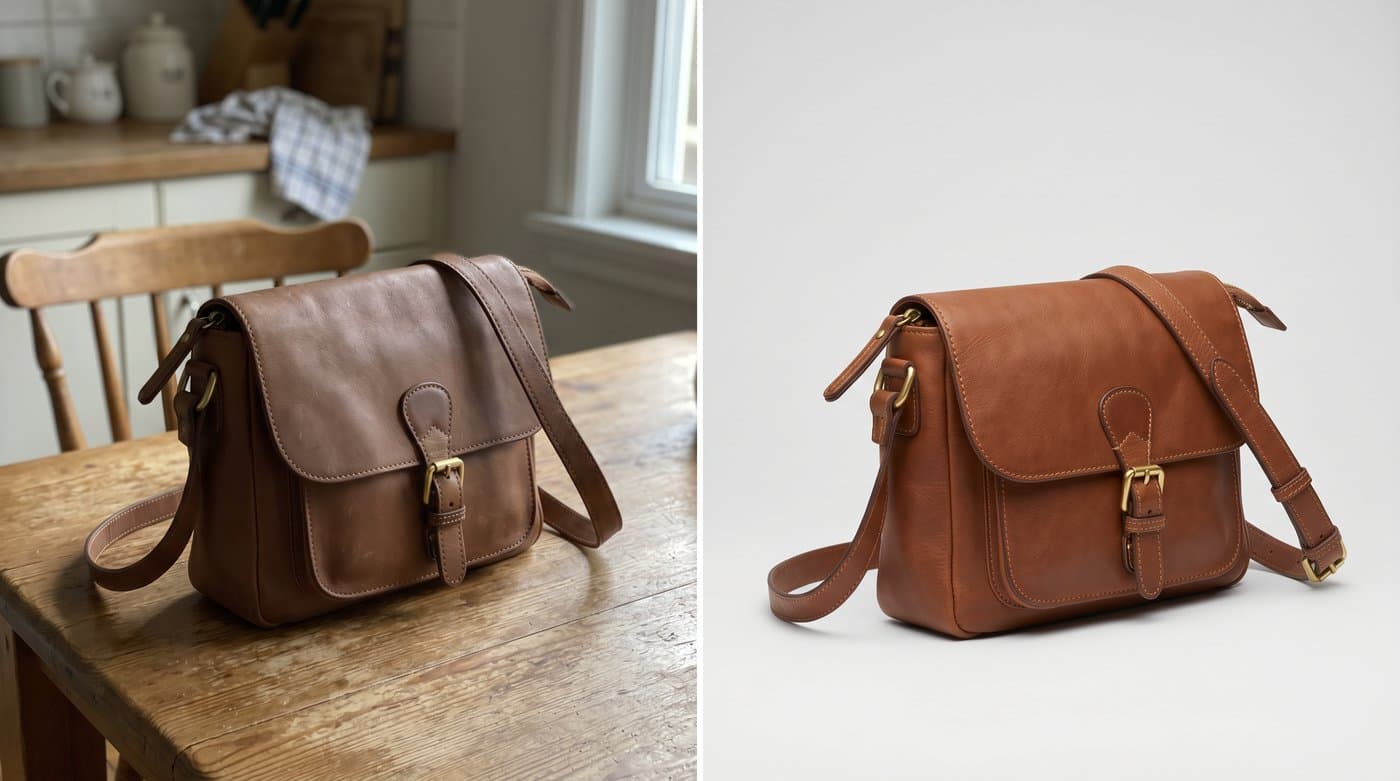
That is the whole proposition in one frame. A seller photographs a product on a phone, and a few seconds later has an image that would have cost a studio booking to produce. Multiply that across a catalog and the budget math changes entirely, which is exactly why generation volume is climbing the way it is.
What it means for sellers
If you sell online and you are still budgeting product photography the old way, the data is a nudge worth taking seriously. The tooling is mature, the cost gap is large and widening, and a large share of your competitors have already moved their catalog work to AI and kept a photographer only for flagship shots. The sensible position in 2026 is not all-AI or all-photographer. It is using AI for the bulk of the catalog and reserving real shoots for the handful of hero images that define the brand. Shoppers reach for images before any text, 56 percent of them first, so producing more strong images for less is a direct lever on sales.
FAQ
How many images were made with Photta between November 2025 and October 2026?
Between 15 November 2025 and 18 October 2026, 41,558 people made 243,509 AI images and videos on Photta, 1,886 of them videos, and 82,593 accounts were opened.
What do online sellers photograph most with AI?
On Photta, clothing: 50.3 percent of the product photos made between November 2025 and October 2026. Jewelry followed with 37.3 percent, then other products, shoes, bags, eyewear and watches.
Which jewelry do sellers photograph most?
In Photta's jewelry studio, necklaces (34.9 percent of the images), then earrings (28.6 percent), rings (21.0 percent) and bracelets (15.5 percent).
Do sellers choose 3D or flat lay ghost mannequin images?
3D, by a wide margin: 33,465 of the 37,178 ghost mannequin images with a recorded style were 3D, and 3,713 were flat lay.
Sources
- Photoroom, AI product photography statistics 2026 (market size, adoption, cost): photoroom.com
- Autophoto, AI product photography and photo editing statistics 2026: autophoto.ai
- Baymard Institute, product page UX research: baymard.com
- Photta first-party platform data, 15 November 2025 to 18 October 2026: completed images and videos from all accounts except test and staff accounts (aggregate, anonymized).